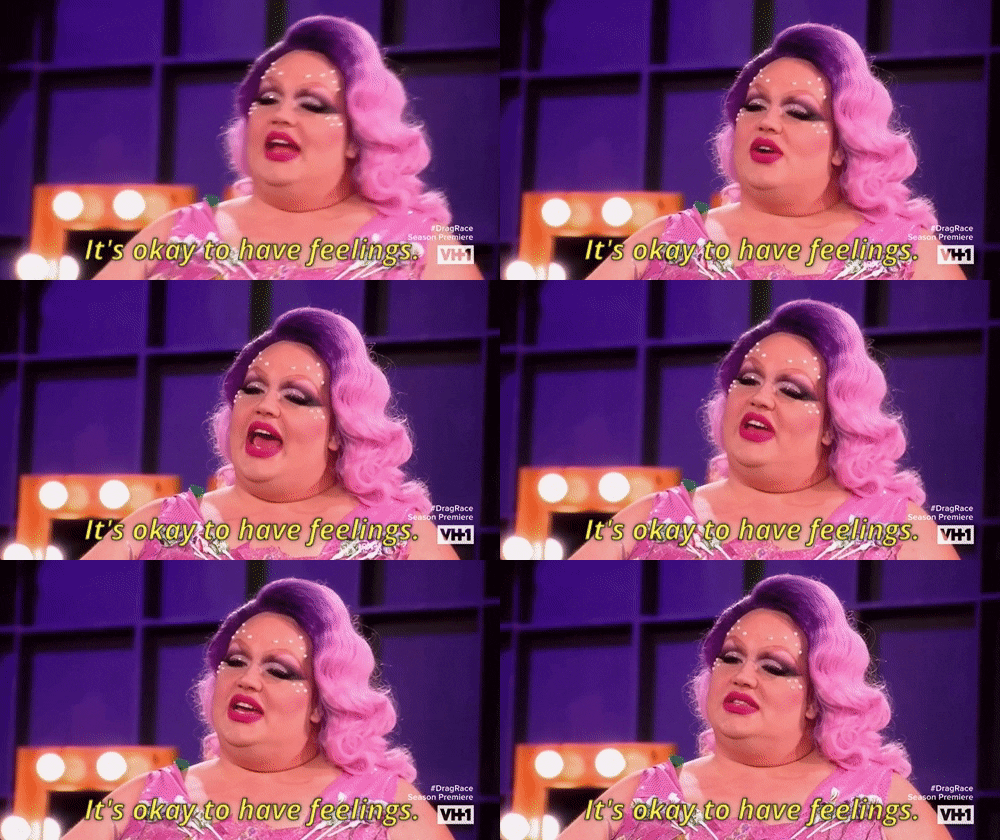
Tuesday, December 31, 2019

Let's Start the New Year Right


Today feels like a lot of endings. Q4 is over, so this is my last blog on emotional resilience as part of an OKR. The year 2019 and subsequently the decade are both over. December flips the calendar back to January and it should feel like a fresh start, a clean slate.

The reality is that tomorrow will come, and aside from not going to work on a Wednesday it will feel like just another day. There is no magic spell that happens at midnight that will suddenly propel me into a new version of myself or a better head space or a luckier life.

As we are faced with so many endings that can feel sort of empty, I wanted to take a moment to remind all of us that true change and happiness can be gradual and that not feeling like a brand new shiny person on January 1 doesn't make you a failure. Not making New Year's Resolutions is not a failure. If there was only one thing that you take away from all of my musings this quarter, I would want it to be that the path to resilience and fulfillment looks different for everyone. You have to find what works for yourself!

With that in mind, I wanted to close out this year and this blog series with a couple of "non-resolutions" I am taking into 2020. I call them non-resolutions because I am not expecting any definite results here; I am not setting out any formulas or giving myself the pressure of hitting some numeric indicator. These are more like reminders for myself- touchstones that I can go back to when I start to feel like I am failing in some way or letting someone else down. Much of this has come from the research I've done into emotional resilience this quarter, but I also have gotten to know myself so much better in 2019 and that growth will probably be reflected in these non-resolutions also.

1) Love yourself the way you love your best friend.
When I was going through a particularly hard time earlier this year, I was struggling to find any value in what I was doing day to day. I felt like I was directionless, and I was being very hard on myself for not being more organized or motivated or inspired. I was expressing this frustration to my roommate, and she stopped me and said "hey. You've got to be nicer to my friend." If you can't find it within to be kind to yourself right now, stop for a moment and consider how you would treat a close friend or partner who was feeling the same way you are. Chances are you wouldn't belittle them or push them to be different- you would encourage them and speak life to them. You would make sure that you looked them in the eyes and made them understand that even when life is the pits you are on their team. As we head into a new decade, give yourself the benefit of the doubt and extend that same grace you would give those you care most about. You're worth it, and it's true. ♥

2) Get to the root of the feeling faster.
This is one of my biggest areas of growth from 2019 so I want to be sure to keep it top of mind in 2020! I'm practicing the CALM MO I wrote about in my last post and making a dedicated effort to try and understand my own emotional life better. By practicing being mindful of the things that make me happy and why they do, I am retraining my brain so that I can do the same when I am feeling sad or angry or stressed. I look forward to more and better results as I continue to be honest and transparent with myself about how I'm feeling and why!

3) Expectation is not a good motivation.
In fact it shouldn't really be in the equation at all. There are P L E N T Y of other reasons to do (or not do!) things. Life and all of the options available in it are rarely ever black and white boxes, so if you are faced with a decision on what to do, don't be afraid to approach it creatively. If you are given two options but can see a third one too- ask! The worst thing you will be told is no, and there is nothing lost in doing so. I am not talking about expectations of performance at work- I am talking about not being obligated to act one specific way just because a label has been assigned to you. There is no one right path, so make some choices that surprise yourself and enjoy the journey it takes you on.

Last but not least, I wanted to link a bunch of resources that I found helpful on this learning adventure. There are a bunch of links here, and most of the time one thing led to another and then another. I cannot recommend it enough to check out all the resource available on LinkedIn Learning. I hope this has been as helpful for you as it has been for me, and here's to a new year of growth!

26 Questions to Help Know Yourself Better
Developing Gratitude
In Praise of Gratitude (this was my favorite article!)
Learning How to Process Negative Emotions
Reasons Why You Make Bad Decisions
Mood Tracking Inspiration

BONUS: I tried to fill my mind with good things and not negative, so I flooded my social media feeds with helpful (or at the very least happy) content! Here are a few of my favorite and most uplifting follows on Instagram this year:
@heyamberrae
@ruthielindsey
@nathanwpylestrangeplanet
@studiodiy & her husband @jeffmindell

.
.
.
.
.
.
.
.
.
.
.
.
.
.
.
.
.
.
.
.
.
.
.
.
.
.
.
.
.

As a prize for making it to the end, please enjoy this Baby Yoda because he's the real source of all joy, forever and ever. 


Tuesday, December 24, 2019

Being Alive

Isn't being alive just the best, most wonderful, weird, crazy, stressful experience? If I've learned anything from writing this blog over the last 10 weeks or so it would be that we know so much more than we give ourselves credit for, but we also pretty much know nothing in the grand scheme of things 😂 With that in mind, let me try and help expand your knowledge just a little more by examining the role that negative emotions play in our lives.


We've already covered how to cope with the day to day stressors that accompany this job. It is not uncommon to have a bad day or even a bad week sometimes! If you need a refresher, check out my post on Vampires and how to overcome them. Today, however, I want to delve even deeper and look at negative emotions and how we can try to identify them and cope with them effectively.

As I often do, I feel it is important to say a few things before diving all the way in here: I am not a doctor, nor do I have any medical background. There are very real circumstances and conditions that may require more help than just trying to shift your mindset, and if that is the case then there is absolutely no shame in that! If that is your situation, please know that I am for you and with you and that this is not meant to be a slap in the face or a dismissal of those realities. These are merely some suggestions I can offer based on my own experiences and research. 

Ok. Let's start by putting some parameters on what we are talking about! "Negative emotions" can be any emotion or sense that makes you feel uneasy or unhappy. Common iterations are fear, guilt, confusion, grief, embarrassment, jealousy, resentment, regret or self-pity. These are naturally occurring emotions that literally every human experiences, and yet we can still feel very isolated when we are experiencing them.

We tend to consider negative emotions to be dangerous. They can be brutal or painful, yes, but they are not the enemy. When we try to repress a feeling that we consider to be dangerous in some way, we are basically engaging in emotional warfare with ourselves. These feelings exist to help develop and refine us, not destroy us. Dr. Gregg Henriques notes that it is important "to understand that you have a 'heart' that is feeling things in your body and a 'head' that is narrating things."

Picture your "heart" and "head" on a teeter-totter. Your heart (i.e your emotions, feelings and gut instincts) is on one side and your head (logic, practicality and your personal narrator) on the other. A lot of interactions and experiences in our lives can be balanced out pretty naturally and they head and the heart keep each other in check. Negative emotions, however, can weigh heavier on one end than the other of the scale and try to pin it down, leaving the opposite helpless and stuck. We experience emotional difficulty is when we try to let one or the other take full control, especially when the side we want to be running the show is stuck on the up side of a broken see-saw. A vicious cycle can be created, for instance, when your emotions are overwhelming you but you try to let logic control it. You may end up feeling even more triggered, attacked or overwhelmed which in turn makes you crave even more control. Outside stress is just amplified when you add internal pressure to it! This works both ways, but part of learning to be our best selves means finding the proper balance between our heads and our hearts.

SO. What can we do when this spiral starts happening? The answer can often lie in mindfulness! Dr. Henriques recommends developing a "new meta" perspective. This means setting up some boundaries and expectations for yourself around negative feelings and how you relate to them before you are in the midst of them. By taking intentional steps to try and step outside of your first person experience and process your emotions and thoughts you can help yourself process your thoughts and feelings in a productive way. It's all about gaining perspective on your inner self by identifying your thoughts and feelings about your thoughts and feelings, hence the term "new meta." This is not to say that you will have some bunker mentality plan made up ahead of time that will help you stamp out negative emotion entirely. Rather, it means practicing your mindfulness in positive situations so that your neural pathways are trained to do so in times of stress as well. Consider using the acronym C.A.L.M.: Curious, Accepting, Loving, and Motivated.

When you start to feel an overwhelming emotion, start with Curiosity. Ask yourself a few clarifying questions about it! No matter how simple the answer may be, try to remain honest with yourself about why you are feeling a particular thing. As you are identifying the emotion you are experiencing, remember to extend yourself the same grace of Acceptance and Love that you would give to your best friend if they were in your shoes. Remember that you are only hoisting more stress onto yourself when one function tries to overtake the other, so give your self a break if you feel this happening; no need to exacerbate the issue. Lastly, remind yourself of your Motivations behind identifying what is bothering you. It is essential to your overall well being as a human, an employee, a friend, a partner, a family member... the list goes on.

When you can change how you choose to respond to tricky emotional situations you will start to see the fruit of a more balanced life start to bloom. You'll find yourself in a healthy and resilient place instead of n exhausted and overwhelmed one. Just remember that negative emotions are not the enemy and they exist to develop and not destroy you! You are amazing and your thoughts and feelings have value- remain C.A.L.M. and you'll find yourself carrying on in no time ♥

Wednesday, November 27, 2019

Count Your Blessings Instead of Sheep


This week on the emotional resilience train we're talking gratitude! I have been pumped on this post for a few weeks now, ever since I realized that this topic could line up so perfectly with Thanksgiving. Before we dive in though, I want to mention two things:

First, I know that finding things to be thankful for can be easier for some people and harder for others. Life comes at us all differently and we all process it in our own unique ways. If this is something that does not come naturally or easily to you, there is no judgement here!

Second, we also all live seasonal lives- maybe you're having a mountain top moment and everything feels clear and wonderful, but maybe you're really walking through a valley of a truly sad or lonely or painful time. If that is the case, reading about how "easy" it is to try and be thankful can feel like a real sham, and I can't say that I would disagree if I was in a different place. This isn't meant to be a slap in the face, and if you know it would not serve your best interest or health to read it, please don't. ♥

Ok! Let's dive in! Gratitude is defined as "a feeling of appreciation or thanks." It is both a virtue AND a skill, which is a super important distinction to make. A skill is something that you work at to learn and often has specific applications. A virtue is a behavior that any given individual is more predisposed to and can be identified as such in any circumstance. This distinction means that being thankful and practicing gratitude literally comes easier to some people more than others, which is WILD.

Evolutionarily speaking, we as humans developed something called a "negativity bias" as part of our instinct to survive. It was very practical when we needed to identify threats to our physical well being on a more consistent basis- think dinosaurs and bears stalking us as prey. It's less helpful, however, when you're just stuck in traffic on I-5.

Ryan Englestad wrote that "people are more familiar with and focused on the obstacles holding them back instead of the resources enabling them to succeed." To be happy in general, this means that we've got to find a way to bring balance to the way we approach difficult situations in our lives. Being able to overcome obstacles, both professionally and personally, is a key part of becoming more emotionally resilient.

This is where gratitude comes in.

When we seek to investigate what is good in our lives, we are literally re-wiring our brains by creating new neural pathways. It certainly takes practice to be mindful of the good things we are surrounded by, and truthfully sometimes the things we "should" be happy for can be really irritating... this is because life is very rarely black and white. It can feel reductive to say "I'm thankful for my family!" when you are estranged from your brother, or "I'm grateful for my job!" when you're actually having a hard time even wanting to show up every day. 

The key is not to rush yourself. If you are having a hard time thinking of things to be thankful for, start by just identifying the things that are neutral; not bad but not great, just normal. In the context of work, think of it as identifying obstacles that you encounter. If you're starting from the mindset of "I'm a failure," don't try to just fake it until you make it out. Instead, let yourself take baby steps in assessing the issues. You can use this handy flow chart if you like!
"I'm a failure" ➜ "There were identifiable reasons why I did not do as well as I wanted." ➜ "I am not fully pleased with this, but I can identify at least one success in this circumstance." ➜ "I am grateful to have had the opportunity." 

Identifying things like this at work and being able to change your outlook on them will trigger success! When you are grateful for an opportunity or a situation you are more motivated to improve your standing within in. As we learned earlier from Ryan, humans can have a hard time seeing solutions when they are focused on problems. Use gratitude to start shifting your mindset off of issues and onto successes! 

When it comes to practicing thankfulness in general, you have to find what works for you. Some of the most common things that people report using to improve their consciousness of good things in their life include keeping a journal, writing thank you notes or letters to meaningful or positive people, meditation or prayer, and making vision boards.

From personal experience, I can tell you that I have loved using the Happiness Journal that Ruby puts out. Not every item that I write down is equal to the others; it is possible to be thankful for your grandmother and jello at the same time. I found much more happiness to be found when I gave up trying to dig deep every day and only write down super profound things. There is SO MUCH joy to be found in the little things because they all add up. Also, consider the things in the past and future that you can be thankful for! You can draw from the memories of your past, the good fortune in your present, and the hopes you have for the future.

This week, as we celebrate Thanksgiving and are often perhaps asked to identify things we are thankful for, try to be specific. Get adjective heavy. Tell people how you feel about them, even if they may already know. Perhaps more importantly, tell yourself how thankful you are to be alive and take a few moments to just breathe in and savor it. Because no matter how you slice it, you're here! You're here and you have every opportunity to choose gratitude- but if you need a little help, I'm here for you too. ♥

"Acknowledge that there is goodness in your life, and then recognize the sources of the goodness and that they are partially outside the self." - Dr. Robert Emmons


If you're looking for more reading on gratitude and how good it is for you, check out some of these resources!


Friday, November 15, 2019

Getting to Know You


But for reals, who are you?

This is a question that I did not quite expect to run into on my research this quarter, but it did not take too much reflection for this query to make TOTAL sense in the grand scheme of things!

Lets back up. So far we've established that it is important to be emotionally agile at work (and just life in general TBH.) We have also learned that we can affect our day to day mental and emotional health by intentionally filling up our own bean buckets with simple and sustainable acts of self care. I've tried to be open ended in my suggestions because while I know what has worked for me, some of those things may not be your cup of tea! You are going to know best for yourself and can adjust, copy or ignore my tips accordingly.

What I've discovered, or perhaps assumed and taken for granted, is that you have to know yourself in order to help yourself. If you aren't sure of what will work to make you happy or what triggers you it can make navigating all of this so much more of an uphill battle. And! Sometimes there are things out of your control that affect your daily life that you may not even have words for! You can see why it becomes so central to your emotional well being and care that you really get to know yourself.

Oh, you need some more convincing? Well, buckle up then. Consider this concept just from the point of view of work. Ruby published a truly fascinating article on Linkedin Learning about the concept of "deep acting-" How to Manage the Hidden Stress of Emotional Labor. I highly recommend it if you have a few minutes to spare! Essentially, the article explains the difficult balancing act of working in customer service and how it can be difficult to reconcile your own personal beliefs and experiences against those of the people you are serving. Seriously, get into it if you can. All that to say, it is extremely stressful if you constantly feel like you are putting on a mask, especially if you feel like you are floundering on how to define who you are underneath it.

Knowing yourself better can help you choose a path that you will succeed in, and will help you have the confidence to tackle challenges that you will face on that journey. It will also make it easier for you to establish a healthy work/life balance by acknowledging how much you can handle in any given situation. Lastly, if you are confident in yourself you are much more likely to know your value to the organization you are in. You will be able to stand up for yourself and ask for what you need because you recognize that you ARE important and you ARE essential.

So how can you get to know yourself and gauge where you're at on the scale of self realization? There are lots of places to start. It may sound cheesy, but take a basic personality test. Let somebody else help you put words to why you are the way you are. I have experience with both Meyer-Briggs and the Enneagram, and I can say from experience that it is hard and wonderful all at once to find out that a test knows you so well. If you are looking for resources on either of those, let me know and I can point you toward some great content.
Journaling is another common practice in getting to know you. It is helpful to work through some prompts because it gives you a sense of direction and not just aimless wandering. Pick out some questions that challenge you or some where the answers don't necessarily come to you right away. There are countless blogs and articles with suggestions of questions, so I tried to narrow it down and put the list at the end of this post.

Pro Tip: Try going through the list on your own first, and then if you feel comfortable you can discuss the questions with a trusted friend or family member. Someone who knows you well and that you trust to be kind and honest with you. In my own life, I have found that my closest friends can often pin point something about me that I am blind to.

Before you start any of this, there are a couple things that you have to be prepared to do for the process to be most effective.
- You must be willing to be vulnerable. Put yourself in the head space and make yourself comfortable with confronting things about yourself that are scary or undesirable. Try and remember that every weakness or flaw that you identify is an opportunity for growth, and that every strength you have can also be a crutch. Nothing about you is perfect, and that is okay!
- You must be willing to be fully honest with yourself. If you are not going to tell yourself the truth, the whole truth, and nothing but the truth then this exercise is pointless. Whatever you are going to discover or articulate through these questions deserves your full acknowledgement.
- You must be compassionate with yourself. YOU ARE NOT PERFECT. No one expects perfection of you either, and if they do then please see my previous post on vampires. Cut yourself some slack, and avoid the comparison game at all costs. This is about getting to know YOU, not anyone else, and that includes not measuring your life up against someone else's.

Now you may proceed.
Treat yourself with the same care that you would give your best friend. If you can be nice to them, then you can be nice to yourself too! And hey, in case you didn't already know, you deserve to be treated kindly. I hope that these questions can help you get to know yourself a little better and that it all points you toward self actualization and care!

And, just for continuity, lets end how we began. With Will Ferrell.

My heart to my brain when I take myself seriously: 

Questions to ask yourself:
  1. What are my strengths?
  2. What are my short-term goals? 
  3. Long-term goals?
  4. Who matters most to me- who are my support people?
  5. Am I an introvert or an extrovert- am I energized being around others or being by myself?
  6. What can I do to make my daily life feel easier?
  7. What "white lies" do I tell myself and others? Why?
  8. What do I want more of in my life? Do my short and long term goals support this desire?
  9. What can I celebrate about myself?
  10. Where can I invest in myself by learning or strengthening skills?
  11. What am I most grateful for in my daily life?
  12. Is there anything that I need to let go of?
  13. What do I want less of in my life? Do my short and long term goals support this desire?
  14. Do I make most decisions from a place of love or fear?
  15. Am I avoiding anything right now? If yes, why?
  16. Am I underestimating myself in any area of my life?
  17. What do I do to show myself self-compassion and self-care?
  18. How do I know that I am stressed?
  19. Is there an area of your life that you feel out of control?
  20. What is the last nice thing you did for someone else?

Friday, November 1, 2019

Vampires

"Die Vampire, Die!"
This is the title of a song in one of my most favorite little musicals called [Title of Show]. The plot revolves around two friends who are trying to write a musical about trying to write a musical with the goal of submitting it to a theater competition. It's a short show with just 4 cast members and a piano, I discovered it by accident my freshman year of college and it is SUH GOOD. During this particular song, the best friends/cast mates of the pair writing the show are trying to cheer them through a serious bout of writers block and self doubt, and they encourage them to kill off the vampires that may fill them "thoughts of self-consciousness, feelings of worthlessness, they'll make you second guess..." and that is what I want to do today. They go on to define vampires as any person, thought or feeling that stands between them and their creative self-expression; I'm here to broaden up the definition in an effort to help us all come to a place of valuing our personal happiness and elevating our self-compassion.
SO! Long introduction aside, this week on the blog I want to focus on some strategies for dealing with stress and other pesky vampires we may encounter at work.

Just the other day, I took a call from a woman named Donna. The call started normally enough- she asked to speak with her son's attorney and I placed her on hold while I tried the line. When I returned to the call to let her know that the lawyer was away from her line but that I would be happy to take a message, things got wild. Donna was immediately irate and told me that I needed to put her directly through because she had called and called and called and had not gotten a response yet. The call ultimately ended in me disconnecting because it was clear that I could not deescalate the situation. Now, I am not calling Donna a vampire. She was having a rough day, and I would certainly be stressed out if I had a child in prison and couldn't seem to reach his lawyer for help. If I had known before I offered to take a message that she had called multiple times I would have approached her call so differently, but you don't know what you don't know, so I did my best.
Suffice it to say, I was caught off guard by the whole whirlwind encounter with Donna. I hit noACD to take a moment to breathe as you often need to after a call like this one. If you took the class on dealing with frustrated callers a few months ago, you might recognize that my amygdala had been hijacked. The amygdala is the part of your brain that processes emotion, and when you come up against a situation that sets it into panic mode it can be hard to come back down from it.
In this moment, I could have totally dwelled on why the call had gone badly and blame myself for it. I could have been angry or irritated that Donna would speak to me, another human, like that. I also could have been miffed at our customer for not answering her line and letting a situation like this escalate to this point. Instead, I told myself that I had done my best on the call. I reminded myself that it was not me that Donna was angry at, it was the situation, and she was not equipped in that moment to give me a chance to try and help. I just released myself from carrying that call with me through the rest of my day.

What about a day that just sucks it out of you? A day where it feels like you barely have any bandwidth left and that the call volume has been out of control? Sometimes it is not necessarily a day where you can pin point a specific call that stressed you out, but the whole environment just feels frantic... what do you do? This can be a harder needle to thread because you don't want to abandon your team when the going gets tough, and sometimes you can't step away. Here are a few things I try to do for myself on days when it just feels non-stop:

- On every break, engage with other humans. You don't have to leave your desk to do it, and the way that you choose to interact is totally dependent on what makes you happiest. Some people thrive by heading to Create Community and just chatting it up with whoever they are lucky to find. For me, it's usually a text to a friend or my mom- not to complain about work, but to see what else is going on in the outside world! Refresh your perspective and get out of the head space that can start to feel like a literal box you are stuck in.
- Find or create moments designed for joy. If you're struggling to get through a crazy day, chances are your co-workers are too. Find something that makes you smile and share that sucker! Maybe a gif or a funny meme or a link to a zoo live cam somewhere... whatever it is, spread it around. At the very least, even if you don't have the strength left to search something out, someone else probably does. Send out the bat signal to your team or a buddy and ask them to send you a little magic for your day. It's not fair to say there is nothing a video of unlikely animal friends, a random Buzzfeed quiz or a choice vine compilation can't fix, but there are a lot of things that can definitely be made better by them!
- Make plans. Give yourself a future gift and give yourself something to look forward to. My favorite motivation is planning a stop at Starbucks on my way home, or premeditating what show I'm going to watch on Netflix when I get home. Start identifying the things about your life outside of work that you get to go back to when you make it through the rough patch, and actively anticipate them.
- Become a time bender. Sometimes, just parsing up the way I think about time helps me get through the day. Example: when I was in high school and we had to run laps in gym, my best strategy for getting through it was to NOT think about running for 10 minutes without stopping. That felt impossible and unending and I hated it. But if I broke it down and told myself it was just five 2 minute increments I suddenly felt a little more equipped to handle it. At the conclusion of each 2 minutes, I pep talked myself by saying "yes! just 4 more to go!" or "3 down?! you're more than halfway!" This strategy did not make the time actually go faster, nor did it make me hate running any less, and it certainly did not make running any easier for me. What it did was give me was something else to focus on and make the time pass faster. On really hard days, I find myself saying "okay, just 2 more 15 minute increments before lunch. You got this." Pep talk yourself and trick your brain into thinking that time is passing faster than it really is.

Vampires are unavoidable. Sometimes they sneak up on you and sometimes they slowly creep in. Either way, the best thing you can do when you encounter one is face it head on. Hopefully some of these tips can be part of your slayer kit of emotional health! We can start by being kind to each other and ourselves, and then the rest will start falling into place.

Tune in next time for more emotional resilience tips and tricks!

Image result for silly vampire

Thursday, October 17, 2019

A Very Good Place to Start

"Let's start at the very beginning..."
A classic Rogers and Hammerstein lyric, a Julie Andrews affirmation, a truth, and where I aim to start from in this blog. I am new to this, but my goal is to educate myself and become a resource to others on how to be more emotionally resilient, especially at work. Join me as I aim to get better at handling tough situations and hard days, and lets walk toward becoming our best selves!

Image result for let's start at the very beginning

So. Emotional resilience. I don't want to bore you with a bunch of facts, but it is important to have a base understanding of what it is we are talking about in the first place. When I say that I want to become more emotionally resilient at work, what I mean is that I want to be able to bounce back from frantic or stressful phone calls quickly. Your capacity to do this depends on a huge number of factors and is therefore different from person to person. It might even be different for you from day to day! This of your personal resilience capabilities like a muscle: it needs to be exercised, it can grow, and it can feel weak occasionally or chronically.
(If you WANT a lot of scientific facts, check out this post on Positive Psychology.com- it is chock a block full of any and everything you might want to know!)

As we head down this road, think for a moment about your own emotional resilience as a bucket full of beans. The things that happen to you over the course of a day will either add or take away beans from your bucket. Low stakes might be getting stuck in traffic or watching a funny Youtube video; higher stakes might be getting recognized for something you worked very hard on, or having a serious disagreement with a loved one. Each of those experiences either fill your bucket or deplete it! Sometimes we are fortunate enough to approach work with a full bucket, but the truth is that we only have the one bucket for our whole life. If you have something else that is worrying you or bothering you outside of work (spoiler, you probably do...) then you have less capacity than usual to handle stressful situations.

So here's my initial takeaway: if I can approach work with a fuller bucket on the daily, I can be more prepared for hard calls and stressful situations. Over this quarter, we'll take time to explore different and specific facets of emotional resilience, but I'm starting by taking a daily inventory of how I feel when I start work. Each day, scale of 1-10, gets a score. I consider things like how tired I am, if I am grumpy or anxious for any reason, and by considering what my day holds and if it fills me with dread or excitement. I have also started to take an inventory of little things I can do for myself  to bring joy. Wear my favorite cozy socks to work? Yes, do it! Have a playlist locked and loaded with some songs that make me happy? Totes! Premeditated stop for Starbucks on my way home from work? YAHHHHH! Giving yourself things to look forward to can really make a big impact on a bad day.

Finally, for today, here's a link to one of my current inspirational songs. "Same Dark Places" by Jr Jr reminds me that we are all so much more alike than we usually consider. It has become a real motto for me while I have started researching and learning about this topic. My favorite line is in the chorus... "Sometimes in the dead of night when you think you can't make it, you might find I left a light beside the bed for you because I've been there too."

So come along friends, I'll leave a light on for you. 

Let's Start the New Year Right

Today feels like a lot of endings. Q4 is over, so this is my last blog on emotional resilience as part of an OKR. The year 2019 and subs...